The Two Patients: Who Are You Really Treating?
By André Leite and Vinícius Lain, authors of AI in Healthcare.
Every doctor working in a modern hospital is, in practice, caring for two patients at the same time. There is the person lying in the bed, in pain, afraid, with a life story that fits in no field of any form. And there is the other patient, the one who lives on the computer screen, made of numbers, exams, alerts and text boxes. The American internist Abraham Verghese gave that second patient a name: the "iPatient." And he raised a warning every physician should take seriously: the iPatient is at risk of getting more attention than the real patient.
This is not a technology problem. It is a problem of where we put our eyes. A well-built electronic health record (EHR) should free up time for the physical exam, for listening, for that minute when the doctor looks into the eyes of the person in front of them before looking at any screen. In practice, what we often see is the opposite: visits where the cursor blinks more than the patient speaks.
Artificial intelligence enters this story in a way that is counterintuitive for anyone who sees AI as just one more screen, one more piece of data, one more system. Well applied, it can do exactly the reverse: absorb the iPatient's paperwork (transcribing, organizing, suggesting, alerting) to hand the doctor back to the flesh-and-blood patient. Ambient listening tools, for example, can already record an entire visit without the doctor typing a word, preserving the eye contact that the EHR era took out of so many exam rooms.
The real risk is not technology overtaking human care. It is badly designed technology continuing to steal time that should belong to the real patient. The question that remains, and that runs through much of the discussion about AI in healthcare, is easy to state and hard to answer every single day in the rush of a hospital shift: at the end of this visit, which of the two patients did I give more attention to?
This is the kind of tension, between technological efficiency and the humanity of care, that runs through the book AI in Healthcare, written by a surgeon and a hospital administrator who live this friction every day, in practice and not in theory.


Keep reading
Doctors and AI
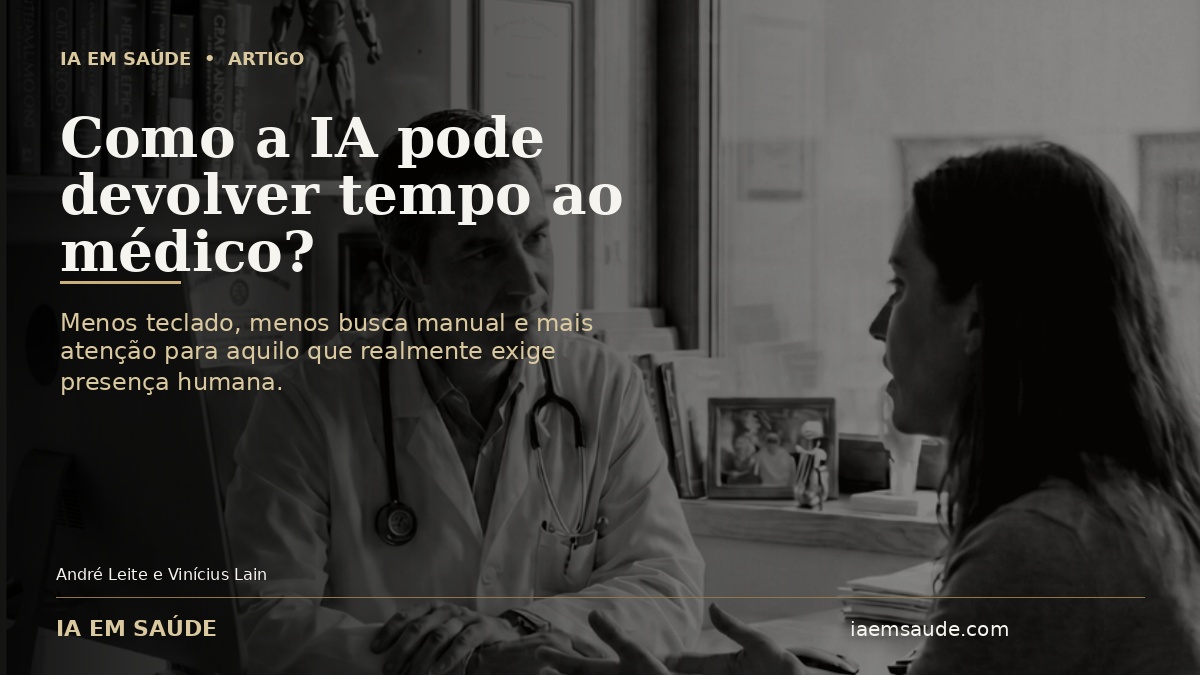
How Can AI Give Doctors Their Time Back?
Ambient listening, record summarization and document automation can reduce the invisible work that keeps doctors away from patients. Learn how to do it safely.
Doctors and AI
Who Stole Eye Contact From the Medical Consultation, and How AI Can Give It Back
Ambient listening: the technology that promises to give doctors back the eye contact the electronic record took out of the consultation.
Doctors and AI
The Elevator Operator Syndrome: Why Trust Matters More Than the Algorithm
The Stanislav Petrov case and the importance of the physician "champion": why AI adoption in healthcare is ultimately a problem of trust, not technology.