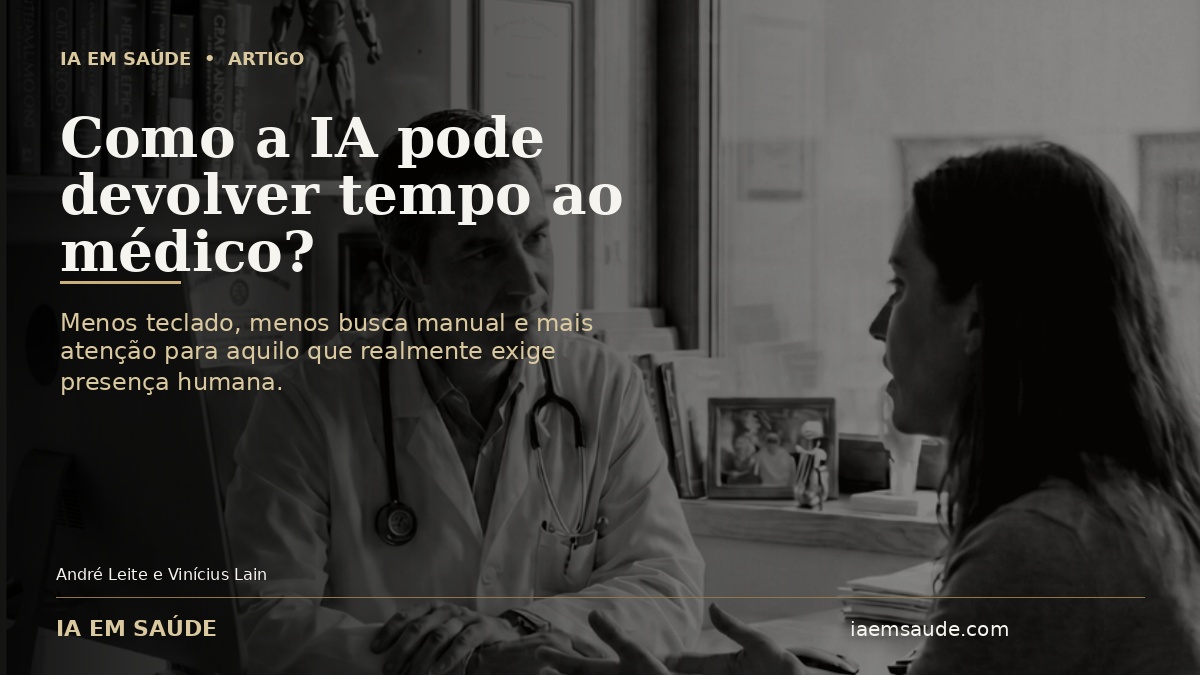
How Can AI Give Doctors Their Time Back?
By André Leite and Vinícius Lain, authors of AI in Healthcare.
Technology came into the exam room promising organization. In many places it also delivered a new kind of distance: the doctor now splits attention between the person in front of them and a screen that demands fields, clicks, passwords and documentation. The electronic health record (EHR) solved important problems, but it created a paradox. Medicine gained a digital memory and, in part, lost presence.
Artificial intelligence can reverse that direction, as long as it is designed to disappear into the workflow rather than add one more screen.
The doctor's second job
Documentation has become a task that runs alongside care. Progress notes, reports, justifications, prescriptions, administrative replies and organizing information take up a big part of the visit and keep going after the last patient has left.
The problem is not recording. Records are essential. The problem is turning a highly trained professional into a manual operator of tasks that could be automated without losing quality.
When the documentation work grows, the bill shows up in three places: less time to listen, more cognitive fatigue and more work outside clinical hours.
The flesh-and-blood patient and the patient made of pixels
In the book, we come back to the idea of the "iPatient": the digital representation of the patient that ends up taking over much of the team's attention. Exams, charts, lists, reports and fields are necessary, but they can become the main focus.
The irony is that the same technology that helped create this distance can now help fix it. The difference is between passive technology, which requires the doctor to keep feeding the system, and technology that can observe, organize and prepare information in the background.
Ambient listening: technology that tries to stay invisible
One of the most promising applications is ambient listening. With consent and proper controls, a system follows the clinical conversation, turns speech into text and prepares structured documentation for review.
This changes the physical and cognitive posture of the visit. The doctor can look at the patient instead of trying to capture every detail at the same time. At the end, the doctor is still responsible for reviewing, correcting and signing the note.
The difference matters: the AI does not "run the visit." It cuts the mechanical work that competes with the visit.
Summarize before the visit
Another quiet waste of time is hunting for information. In long records, important data can be scattered across visits, PDFs, reports and progress notes. Language-processing systems can build a timeline and highlight medications, relevant events, recent changes and open items.
The benefit is not only speed. A well-designed summary can lower the chance that the clinician decides based on the most visible data instead of the most important data.
Turning the plan into action
After the visit there is another point of friction: translating what was decided into a prescription, instructions, documentation and follow-up. Generative AI can prepare first versions of these materials and adapt the explanation to language the patient can understand.
Again, the rule is human review. AI is particularly useful for drafting, structuring and standardizing. Concrete clinical statements, doses, contraindications and recommendations must still go through professional judgment and reliable sources.
The danger of automating the wrong bureaucracy
Not every automation gives time back. Some just speed up badly designed processes. Before putting AI on top of a workflow, you have to ask whether the task should exist at all, whether it could be simplified or whether it is only there as a bureaucratic inheritance.
Automating ten unnecessary fields is still filling out ten unnecessary fields, just faster.
The best implementation starts with the design of care, not with the software.
Three conditions for really giving time back
1. The technology has to be discreet. The more it demands switching screens, commands and corrections, the lower the chance it gives attention back.
2. The doctor has to stay the reviewer. Documentation automation does not mean automatic signing. The output must be transparent and editable.
3. The patient has to understand the process. The use of ambient capture and AI tools needs to be explained clearly, with respect for privacy, consent and the applicable rules.
Time is a clinical intervention
When a doctor gets back a few minutes of real attention, the gain is not just professional comfort. It can mean a better-told story, a question that finally comes up, instructions that are understood or a shared decision of higher quality.
So the most interesting metric for some of these technologies may not be how many notes they generate per minute. It is how much human time they return to the encounter.
AI will be truly transformative when it can work in the back of the room while doctor and patient move back to the center.
André Leite and Vinícius Lain are the authors of AI in Healthcare: How Technology Is Transforming the Future of Human Care.
Read more at iaemsaude.com/en.


Keep reading
Doctors and AI
The Two Patients: Who Are You Really Treating?
Abraham Verghese's "iPatient" concept: the patient of data on the screen can steal attention from the real patient. See what this has to do with using AI in the consultation.
Doctors and AI
Who Stole Eye Contact From the Medical Consultation, and How AI Can Give It Back
Ambient listening: the technology that promises to give doctors back the eye contact the electronic record took out of the consultation.
Doctors and AI
The Elevator Operator Syndrome: Why Trust Matters More Than the Algorithm
The Stanislav Petrov case and the importance of the physician "champion": why AI adoption in healthcare is ultimately a problem of trust, not technology.