Who Stole Eye Contact From the Medical Consultation, and How AI Can Give It Back
By André Leite and Vinícius Lain, authors of AI in Healthcare.
Ask any physician with more than fifteen years in practice to compare a visit today with one from before the era of the mandatory electronic health record (EHR), and the answer is likely to come fast: "these days I look at the screen more than at the patient." It isn't nostalgia. It is a direct, measurable consequence of how most clinical record systems were designed, putting the filling in of fields, codes and billing justifications ahead of the experience of actually being present in the room with the person who came for help.
This has real clinical consequences. It isn't just a matter of comfort. Studies on physician-patient communication link eye contact and active listening to better treatment adherence, greater trust reported by patients, and even better identification of symptoms that only come out when someone feels truly heard, not just questioned from a script.
This is where one of the most promising, and least discussed, applications of artificial intelligence in healthcare comes in: ambient listening. These are systems that can automatically record and transcribe a consultation, with proper consent and data security, and turn that conversation into a structured clinical record, without the physician typing a line during the visit. The document organizes itself in the background while the consultation happens the way it should: a conversation between two people.
Skepticism is healthy and necessary here. Who is recording, where is the audio stored, who has access, how is the patient informed and how can they refuse? All of this needs rigorous governance before any large-scale adoption. But the potential to reverse decades of erosion in the physician-patient relationship, caused not by the technology itself but by its poor design, is real and worth the investment of getting it right.
The promise is not an AI smarter than the physician. It is an AI discreet enough that the physician goes back to doing the one thing no machine can do for them: truly look at the patient while they speak.

Keep reading
Doctors and AI
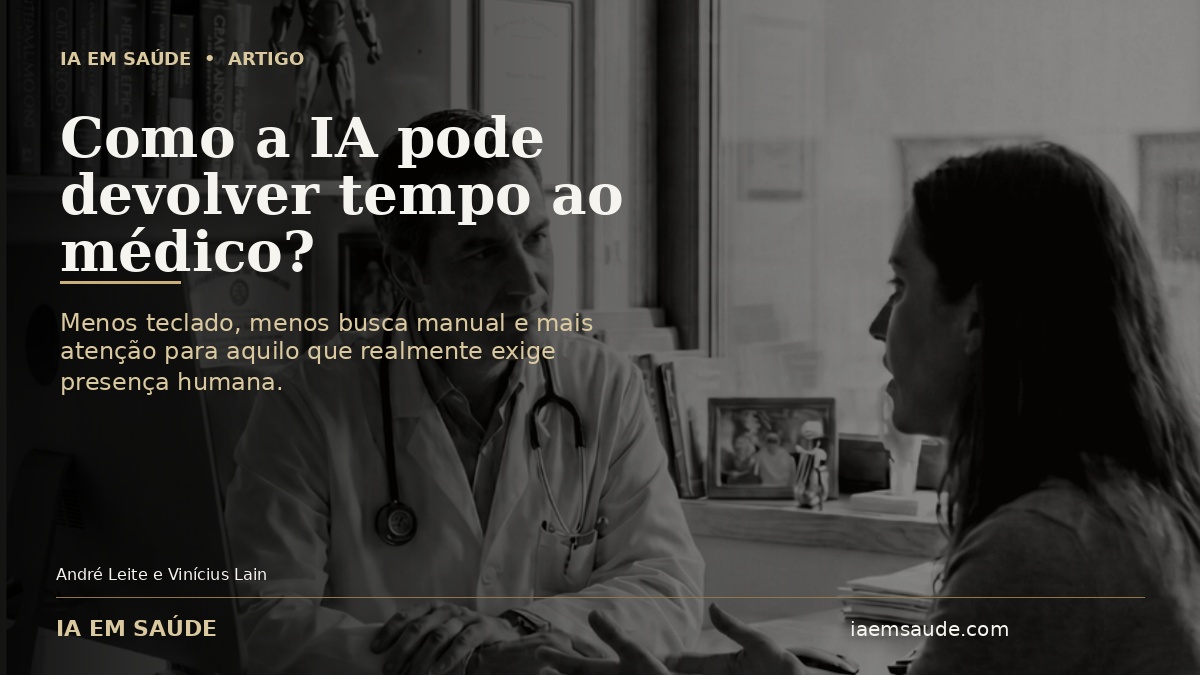
How Can AI Give Doctors Their Time Back?
Ambient listening, record summarization and document automation can reduce the invisible work that keeps doctors away from patients. Learn how to do it safely.
Doctors and AI
The Two Patients: Who Are You Really Treating?
Abraham Verghese's "iPatient" concept: the patient of data on the screen can steal attention from the real patient. See what this has to do with using AI in the consultation.
Doctors and AI
The Elevator Operator Syndrome: Why Trust Matters More Than the Algorithm
The Stanislav Petrov case and the importance of the physician "champion": why AI adoption in healthcare is ultimately a problem of trust, not technology.