Neither Miracle Nor Threat: How to Judge a Medical AI by What It Actually Does
By André Leite and Vinícius Lain, authors of AI in Healthcare.
Every new technology in healthcare arrives wrapped in two opposite and equally exaggerated stories. On one side are the people promising it will "revolutionize" everything, clear the waiting lists, predict disease, end medical error. On the other are those who see risk in every line of code, a black box in every algorithm, a threat in every new acronym. Neither story helps the physician who has to decide, in practice, whether to trust a specific tool for a specific patient.
There is a more useful path, and it runs well away from both enthusiasm and fear: judge artificial intelligence by what it can functionally do. Don't ask "is this AI good?" in the abstract. Ask "for this exact task, with this exact data, validated in which population, with what error rate, and what happens when it gets it wrong?" It is the same standard we apply, or should apply, to any new test, drug or device before it enters clinical practice.
It also helps to understand that "artificial intelligence" is not one thing. A machine learning system trained under close supervision, like a resident learning from an experienced attending who corrects every step, is structurally different from a deep learning model that learns by exposure to millions of examples. The second works in a more opaque way and, in many cases, performs better, but it also tells you less about the "why" behind each decision. Confusing the two is like treating an intern and a senior specialist the same way just because both wear a white coat.
Healthy skepticism is not resistance to change. It is scientific rigor applied to a new technology, exactly what we expect for any advance in medicine. And unchecked enthusiasm is not innovation either. At best it is naivety, and at worst it is negligence.
The right question was never "will AI replace the doctor?" It is "does this specific tool improve my patient's outcome, on what evidence, and under what supervision?" Whoever answers that question rigorously is closer to using artificial intelligence well than someone who just cheers for it or against it.
Keep reading
Foundations of AI in Healthcare
Medicine's Sound Barrier: When the Volume of Data Exceeds What a Doctor Can Process
The "Medical Singularity": why the volume of clinical information has already outgrown human processing capacity, and what that demands of technology.
Foundations of AI in Healthcare
88 Miles Per Hour: AI Doesn't Point to the Future, It Points Back to the Doctor as Healer
A synthesis on the physician's role in the age of artificial intelligence: technology as the engine, human judgment as the steering.
AI in Medicine
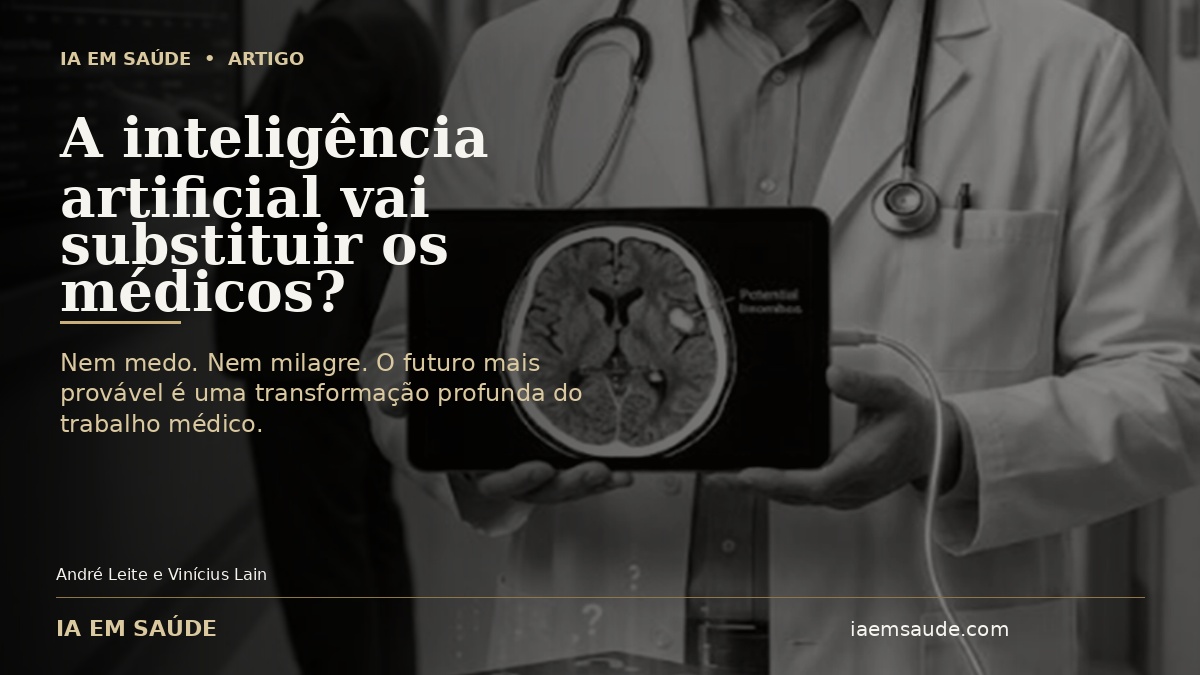
Will Artificial Intelligence Replace Doctors?
Artificial intelligence is likelier to transform medical work than replace it. Learn what the machine can take over, and what remains essentially human.