88 Miles Per Hour: AI Doesn't Point to the Future, It Points Back to the Doctor as Healer
By André Leite and Vinícius Lain, authors of AI in Healthcare.
In the Back to the Future trilogy, the time machine has to hit exactly 88 miles per hour to work. That is fast enough to break the time barrier, yet it is still driven, controlled, and decided by someone sitting in the driver's seat. It's a good image to close any serious reflection on artificial intelligence in healthcare. Technology is the engine, capable of a speed conventional means can't reach, but it still needs someone at the wheel, deciding where to go and, above all, why go there.
In any honest discussion of AI in medicine (imaging diagnostics, predictive medicine, ambient listening, pharmacogenomics, hospital management, cybersecurity, legal liability), the same pattern repeats section after section. The most successful technology is not the one that replaces medical judgment. It is the one that gives back time, attention, and context so that judgment can be exercised better, not with less human involvement.
There is a real risk that medicine, seduced by the efficiency AI promises, will hollow out the physician's role until the doctor is just a systems operator, someone who merely validates what the machine suggests without really exercising the clinical judgment that only human experience, built case by case, can develop. That is the scenario to avoid. The one to aim for is the opposite: a medicine where the physician, freed from the bureaucratic load that poorly designed technology has imposed over the past decades, goes back to fully doing what no algorithm can replicate. That is the role of healer in the broadest sense of the word: someone who interprets, contextualizes, decides, and above all, cares.
The sentence that sums up this vision of the future is simple to say and hard to practice every day: the next decade of healthcare won't belong to whoever has the best technology, but to whoever knows how to ask the best question. Technology without the right question is sophisticated noise. The right question, backed by the right technology, is what separates a health system that merely processes patients from one that truly takes care of people.
88 miles per hour is not the destination. It's just the speed needed for the journey to begin. Where it goes is still the choice of whoever is in command.


Keep reading
Foundations of AI in Healthcare
Medicine's Sound Barrier: When the Volume of Data Exceeds What a Doctor Can Process
The "Medical Singularity": why the volume of clinical information has already outgrown human processing capacity, and what that demands of technology.
Foundations of AI in Healthcare
Neither Miracle Nor Threat: How to Judge a Medical AI by What It Actually Does
Before asking whether an AI is good, ask for which task, with what validation and under what supervision. A practical guide to judging healthcare technology.
AI in Medicine
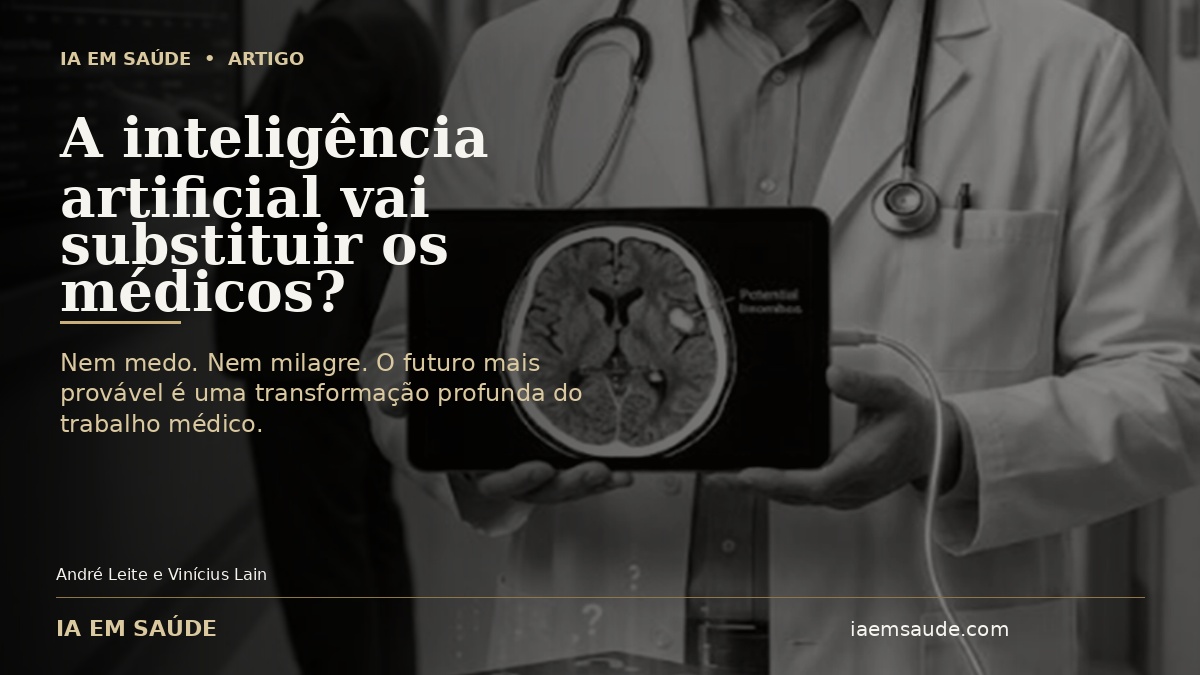
Will Artificial Intelligence Replace Doctors?
Artificial intelligence is likelier to transform medical work than replace it. Learn what the machine can take over, and what remains essentially human.