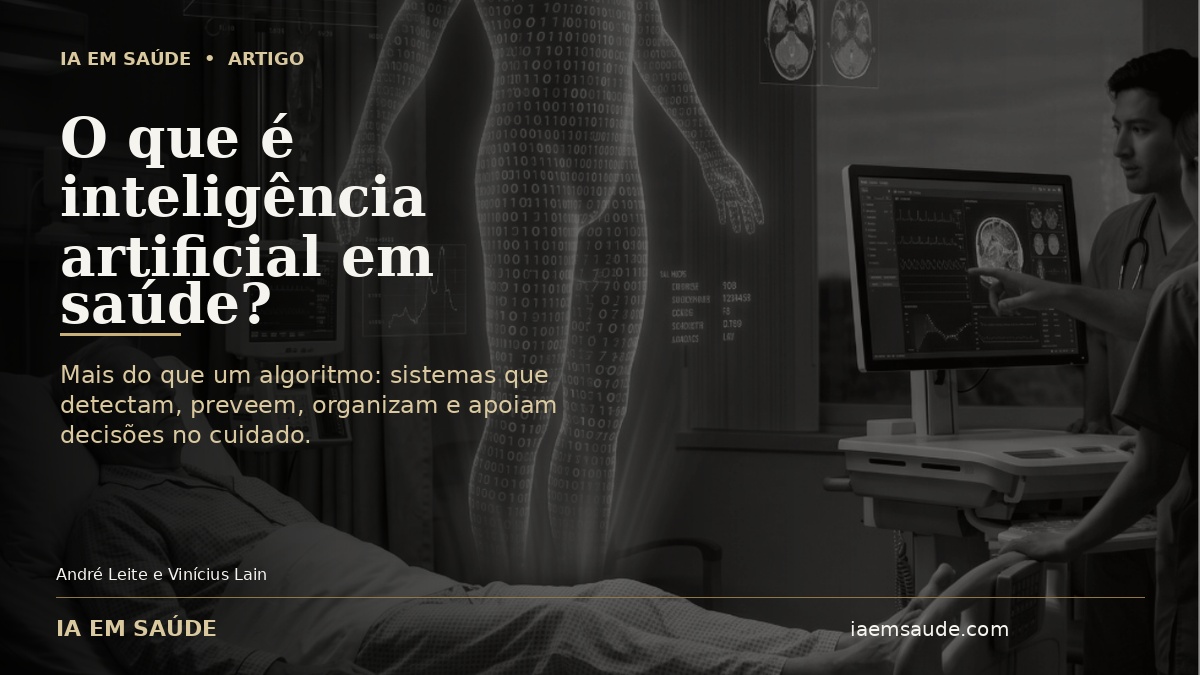
What Is Artificial Intelligence in Healthcare?
By André Leite and Vinícius Lain, authors of AI in Healthcare.
Artificial intelligence in healthcare is the use of computer systems that can analyze data, recognize patterns, make predictions, organize language or support decisions about care, operations and management. That definition sounds simple, but it avoids a common mistake: treating "AI" as if it were one technology with one behavior.
In practice, different systems do very different things, and they fail in different ways. For doctors and administrators, understanding that difference matters more than knowing the name of the algorithm behind the screen.
The right question is not "is this AI?"
In hospital meetings, the words artificial intelligence sometimes show up as a badge of modernity. A piece of software "has AI," a device "uses AI," a dashboard is "intelligent." But that label alone says very little.
The useful question is functional: what exactly does this system do?
Does it detect a change in an image? Estimate future risk? Prioritize an exam? Summarize an EHR? Transcribe a visit? Suggest a billing code? Flag an inconsistency? Each function brings different benefits, different risks and a different need for supervision.
Four big functions
A practical way to understand AI in healthcare is to think in four verbs.
Detect. Computer vision systems can identify patterns in radiology, pathology and other exams. Rather than replacing the specialist, they can highlight findings, prioritize cases and reduce blind spots.
Predict. Models can combine vital signs, labs, history and other variables to estimate the risk of deterioration, readmission or other events. Medicine stops looking only at the current state and starts asking what might happen in the next hours or days.
Organize. Language processing can turn text and conversations into structured information, summarize documents and retrieve data that would stay buried in long records.
Generate. Generative AI can produce drafts, explanations, instructions and summaries. That can lighten the documentation load, but it needs review, because language models can create statements that sound plausible and are wrong.
Machine learning, deep learning and generative AI
These terms come up all the time, but they do not need to turn into a programming class.
In machine learning, the system learns associations from data and can be trained to classify things or predict outcomes. In deep learning, neural networks with many layers can learn complex representations, which is especially relevant for images, signals and large volumes of information. Generative AI, in turn, produces new content, mostly text, images, audio or code, based on the patterns it has learned.
For people who work in healthcare, the central question is less "how was the model built?" and more "which capability has been validated, and which decision depends on it?"
Clinical AI and operational AI
Another misconception is that AI in healthcare only means diagnosis. The impact can be as large outside the clinical act as inside it.
A hospital can use AI to forecast demand, organize beds, reduce operating room delays, track inventory, detect the risk of claim denials (what we call glosas in Brazil, when payers refuse to reimburse), improve coding or anticipate bottlenecks. None of this shows up on a CT scan, but it can directly change the quality and sustainability of care.
The line between clinical and operational is blurrier than it looks. A supply that does not arrive, a bed that does not turn over or a piece of information that does not cross from one system to another can also harm a patient.
AI is not a synonym for autonomy
A system being intelligent does not mean it should decide on its own. In healthcare, the degree of autonomy has to match the risk of the task. A tool that organizes text can tolerate kinds of error that would be unacceptable in a system that prioritizes an intracranial hemorrhage.
That is why supervision, traceability, local validation and escalation criteria are part of the technology itself. They are not bureaucracy added afterward.
Data is the fuel, and also the limit
Every AI system depends on the quality of what it receives. Incomplete, biased or disconnected data produces equally incomplete intelligence. A brilliant model working on a fragmented record still sees only part of the patient.
This is one of the reasons interoperability, data quality and governance take up so much space in the digital transformation of healthcare. Before talking about algorithms, many institutions need to solve something less glamorous: getting their own systems to talk to each other.
The definition that matters
In the end, artificial intelligence in healthcare is not a machine that "becomes a doctor." It is a set of computational capabilities that can broaden perception, reduce cognitive load, anticipate risk and automate tasks.
The value appears when those capabilities are placed in the right workflow, for the right task and with clear accountability.
The technology can be sophisticated. The test stays simple: does it help us take better care of people?
André Leite and Vinícius Lain are the authors of AI in Healthcare: How Technology Is Transforming the Future of Human Care.
Read more and learn about the book at iaemsaude.com/en.


Keep reading

Core Concepts
The Origami That Won the Nobel: What AlphaFold Changes for Your Treatment
AlphaFold, the 2024 Nobel Prize in Chemistry and pharmacogenomics: how AI is speeding the path to truly personalized medicine.
Core Concepts
Hospital 2035: A Day in the Life of a Patient in Medicine's (Very Near) Future
A speculative scenario of the hospital of the future, with digital twins, robotic surgery and continuous monitoring, and the real risk that it will not reach everyone.

Core Concepts
The Foreword Written by an AI: The Experiment That Opens AI in Healthcare
Why André Leite and Vinícius Lain asked the AI Claude, from Anthropic, to write the book's foreword, and what this experiment demonstrates in practice.