Healthcare's Enigma Moment: Is Your Hospital Ready for a Cyberattack?
By André Leite and Vinícius Lain, authors of AI in Healthcare.
In 1942, cracking the German Enigma machine changed the course of World War II. It didn't create a new weapon. It showed that information, protected or not, decides battles as much as any arsenal. Modern healthcare is living through its own Enigma moment, only in reverse: instead of breaking the adversary's code, the health system urgently needs to protect its own code (its data, its systems, its digital infrastructure) from people trying to break it.
In 2017, the WannaCry ransomware attack paralyzed a significant part of the UK's public health system. Surgeries were canceled, ambulances were diverted, and entire hospitals lost access to their electronic health records (EHRs) for days. It wasn't aimed at healthcare in particular. It was a generic attack that found, in this sector, an enormous vulnerability and systems too outdated to hold up. In 2020, in Finland, the breach at the Vastaamo psychotherapy clinic exposed extremely sensitive records of thousands of patients, which were later used for individual extortion. It was a brutal reminder that leaked health data is not just a regulatory compliance problem. It is a direct risk to the lives and dignity of real people.
Unlike other sectors, healthcare carries a double vulnerability. It holds data that is extremely sensitive, perhaps the most sensitive that exists about a person, and it depends on systems running in real time for decisions that literally save lives. A cyberattack on a bank causes financial loss. A cyberattack on a hospital can cost lives, directly and immediately.
The response can't be proportional to the IT budget on hand. It has to be proportional to the real risk. That means continuous investment in information security, and training for the whole team (most successful attacks start with a human click, not a sophisticated technical flaw). It means contingency plans that are actually tested, not just documented in a drawer. And it means an institutional culture that treats cybersecurity as part of patient safety, not as an IT item separate from the care itself.
The question every healthcare manager should be asking today is not "will we be attacked?" It is "when we are attacked, how long will it take us to get back to operating safely, and how many lives depend on that answer?"


Keep reading
Data and Infrastructure
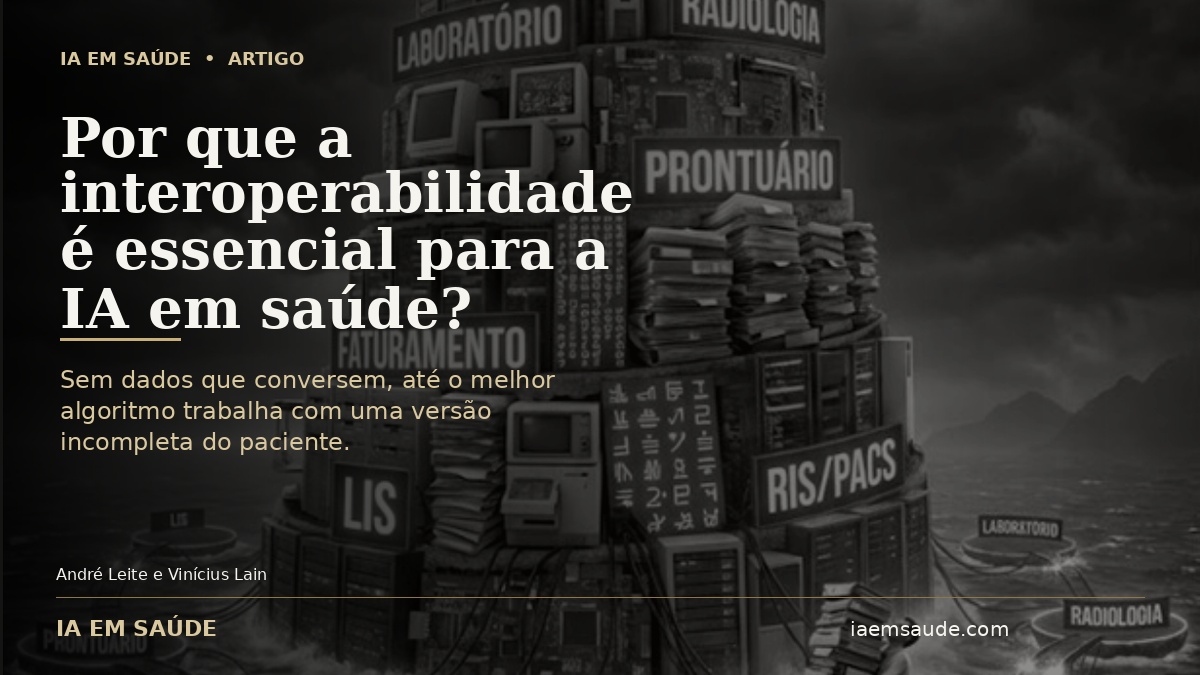
Why Interoperability Is Essential to AI in Healthcare
AI depends on integrated data. Learn why interoperability, APIs and standards such as HL7 FHIR are clinical infrastructure, not just IT topics.
Data and Infrastructure
Data Is Not Oil, It Is Uranium: The Electronic Health Record as the Hospital's Living Memory
Why the "data as oil" metaphor is misleading, and what that changes in how hospitals should treat their clinical data.

Data and Infrastructure
Healthcare's Digital Titanic: Why Your Systems Don't Talk to Each Other
Interoperability, HL7 FHIR and vendor lock-in: why the lack of systems that talk to each other is the silent foundation of all AI in healthcare.